Mission architecture
Counter-UAS EO/IR: From Detection to Handoff
How search, recognition, tracking and handoff fit together, and which test evidence belongs at each stage.
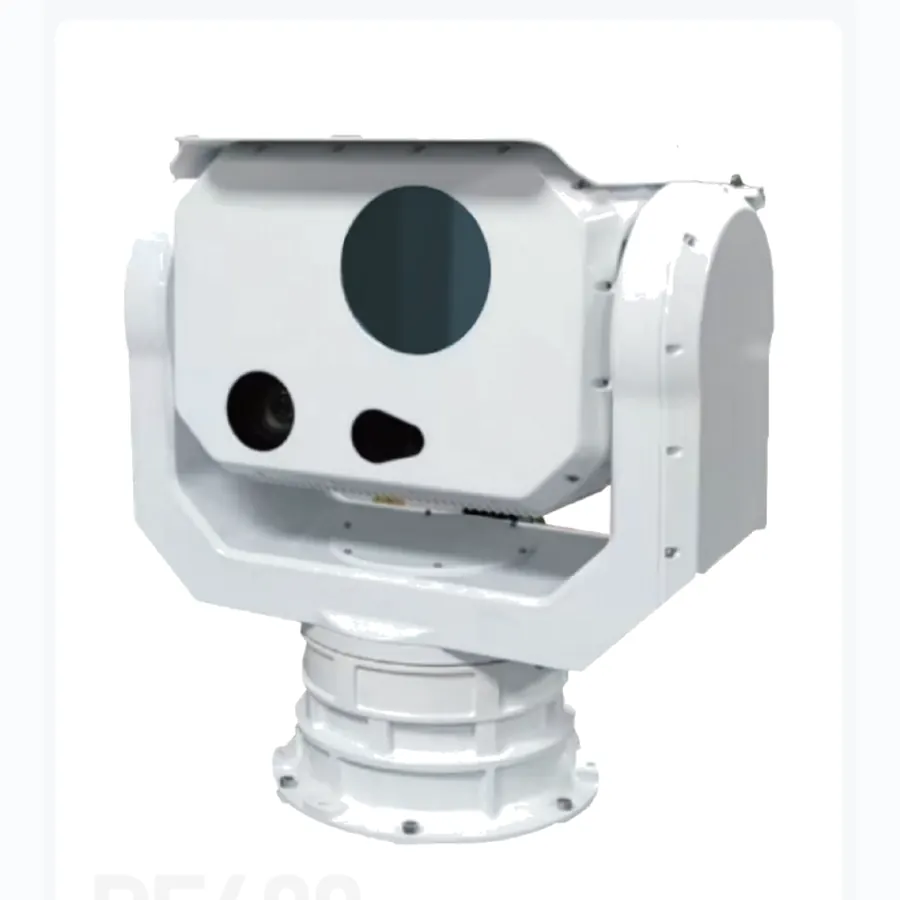
A counter-UAS optical chain is not a single camera. It is a sequence: detect a small object, classify it with enough confidence to act, establish a stable track and hand that track to a response layer. Each stage has a different field of view, latency and evidence requirement. Buying one long-range lens does not automatically complete the chain.
1. Detect across the search field
Wide-area search rewards field of view, frame rate and stable image processing. A fixed-site turret can sweep a large sector continuously; an airborne payload must do the same job within mass and power limits. The PF400 tri-sensor C-UAV turret is designed around a fixed-site 360° scan and rapid lock-on. PD230 and PD240 address persistent surveillance from a pedestal with a 60× visible channel and a 75 mm thermal channel.
2. Classify with the necessary confidence
Detection and classification are different outputs. A moving speck may be a bird, a drone or a false alarm. TK5340 provides onboard AI processing for visible and thermal video, including manual target selection, automatic recognition and multi-target tracking. The integration question is not only whether classification exists, but which target classes, confidence thresholds and failure states are exposed to the host system.
3. Hold a stable track
Once a target is selected, stabilization and control-loop behaviour determine whether the operator can keep it in frame. A narrow thermal field of view magnifies residual motion. Compare the proposed payload at the actual zoom setting, with the actual mount and airframe disturbance. The PV40DYT high-speed rocket UAV pod and DYT70 infrared seeker address different parts of a moving engagement; they should not be treated as interchangeable tracking cameras.
4. Hand off without losing time
Handoff needs a common coordinate, time base and track state. Define whether the downstream system requires angular commands, pixel coordinates, target bounding boxes or a velocity estimate. Confirm the update rate and what happens when the optical track is lost. A fast image alone cannot compensate for a slow or ambiguous interface.
What to test before purchase
- Search time across the required sector and field of view.
- Detection and classification evidence for representative target sizes and backgrounds.
- Track continuity through clutter, occlusion and zoom changes.
- Latency from image capture to control output.
- Handoff format, timestamping and recovery behaviour.
- Installed mass, power and environmental requirements.
Do not compare ranges without conditions. A detection distance depends on target size, contrast, atmosphere, lens, detector and the definition of “detection.” Ask for the test condition beside every range figure.
A practical architecture review
Start with the response layer and work backwards. If the response requires a precise angular track, the optical payload, stabilization and handoff format must be specified together. If the first requirement is persistent awareness, prioritize search coverage and image stability. In both cases, evaluate the chain as a system rather than selecting the largest number in a brochure.
For the underlying sensor and tracking layers, read EO/IR technology. To compare candidate configurations, use the product range or send the target set and platform envelope through the engineering inquiry form.
Write the handoff contract
A handoff is a data contract between the EO/IR system and the response layer. It should define the target identity, the coordinate frame, the time stamp, the update rate, the track quality and the behavior when the target is lost. A video feed alone is not a handoff. The receiving system needs enough information to point, cue or decide without asking the operator to translate what is on screen.
Define the origin and axes of the coordinate frame. Is the track reported in site coordinates, local tangent plane, azimuth/elevation or pixel coordinates? How is north defined? What happens when the target crosses the zenith or passes behind an obstruction? A track that is accurate in one frame but interpreted in another can be worse than no track.
Time is part of the contract. Specify the time source, the time stamp of the video frame and the latency of the track message. A fast target can move significantly during a delay. If the response layer predicts the target position, it needs to know the age of the measurement.
Test cue, acquisition and confirmation separately
Start with a static cue. Send the turret to a known azimuth and elevation and measure the settling time. Then use a moving cue with a realistic angular offset and measure the time to acquire the target. Separate the slew time from the optical settle time and the tracker lock time. A fast slew that leaves the image blurry for two seconds is not a fast acquisition.
Next test confirmation. Present a target and a non-target of similar size or motion. Record how the system classifies each and how long the operator needs to decide. A turret that detects everything but cannot discriminate creates workload rather than situational awareness.
Finally test the handoff with the actual response layer. Send the track and compare the receiving display with the turret display. Check the position, time and identity. Repeat with a target that crosses the field and with a target that temporarily disappears. The handoff should fail gracefully, with a clear indication of lost track rather than a stale position.
Record the failure modes
Counter-UAS testing often focuses on the successful detection. The more useful evidence is the failure mode. What happens when the target is a bird, a distant aircraft or a reflection? Does the system generate a track that looks plausible? What happens when the data link drops, the laser is blocked or the tracker loses the target behind a building? The operator needs to know whether the display is live, coasting or stale.
Record the environmental conditions and the site clutter. A test over open water is different from a test over an urban skyline. A clear-sky detection range may not transfer to a hazy coastal site. The acceptance report should state the conditions and the observed limits.
Keep the track log, video and operator notes together. A video clip without the track data cannot prove the handoff latency or the coordinate accuracy. A log without the video cannot show what the operator saw. The combination is the evidence.
Frequently asked questions
What is the most important counter-UAS metric?
There is no single metric. Cue-to-track time, track continuity, false-alarm rate, coordinate accuracy and handoff latency all matter. The priority depends on the response layer and the site.
Can a turret work without a radar cue?
It can search a 360° panorama, but a small target may be difficult to detect in a fast scan. A radar, RF sensor or human cue can improve the search. Test the full search-to-lock sequence.
How should track loss be reported?
The receiving system should see a clear lost-track state, not a stale position that looks valid. Define the timeout and the last valid measurement in the interface contract.
What should be included in the acceptance report?
The target profiles, environmental conditions, detection and track times, false alarms, coordinate accuracy, handoff latency and failure behavior. Include the video and track logs.